
If you spend enough time in the Zambian bush,
you quickly learn that nothing out here happens in isolation. A rustle in the
reeds can set off a wave of motion…a shadow across the ground can hush a whole
clearing. And sometimes, the key to finding Africa’s most elusive predators…
comes from a set of wings!
Welcome to the world of tracking through birds – one of the most underrated skills on
safari, and a daily tool for our expert guides here at Royal Zambezi Lodge.
While our birding safaris are a paradise for anyone seeking the far-ranging
diversity of Zambia’s birdlife, the joy of watching our feathered friends goes
far beyond ticking species off a list. In the wild, birds can lead us straight
to lions, leopards and other big game – if you know how to listen.
Ready to hear the wild tracking tales of the bush?


One morning, driving in the park southeast of Grass Dambo, our guide Leo heard it – the distinctive, sharp, staccato call of helmeted guinea fowl. It wasn’t the casual flatter of a flock. This was urgent.
He stopped the vehicle. The guests looked around puzzled. “What have you seen?” one asked.
“Not seen, heard.” Leo told the guests that the guinea fowl were telling them something.
Helmeted guinea fowl are nature’s little sirens. When they spot danger – whether it’s a snake, a martial eagle or a stealthy leopard, they kick up a raucous alarm that can carry far across the bush.
The guests exchanged doubtful glances, but Leo eased the vehicle towards the noise, eyes scanning under the bushes. Then, one of the guests spotted it, hanging high in the fork of a mahogany tree.
“Look!” she gasped. “An Impala kill!”
Leo knew exactly what that meant.. That a leopard was close. Sure enough, just 10 minutes later, the female leopard revealed herself, resting in the shade only a few metres away from her prize.
The mood shifted instantly – the guests were amazed! Cameras clicked, and everyone had just learned one of the bush’s most important rules: never ignore an alarm call.
That morning, the guests discovered something remarkable: birds aren’t just beautiful sights or sounds – they are guides to the bigger wildlife around us. And this is exactly why tracking with birds has become one of the most reliable ways to find Africa’s elusive predators.
Across Zambia, from the Lower Zambezi River to the miombo woodlands, birds are constant companions – not just to us, but to every animal. And because many are prey species themselves, they’re always on guard.
Here are a few of the feathered friends we often rely on while tracking big game:
Oxpeckers – Often found clinging to the hides of buffalo or hippo, feeding on ticks. Hear a chorus of their high-pitched calls? You may have just found a herd – or a big bull, nearby! Fun fact: oxpeckers will sometimes peck at wounds on animals to feed on blood, but this also gives early warning of predators nearby. On safari, a noisy oxpecker can mean a large herd or a lone bull is just around the corner.
Fork-tailed drongos – Small but fearless, these black songbirds mob hawks, snakes and even jackals. Sometimes, drongos mimic the alarm calls of other species, sometimes tricking animals into dropping food so they can snatch a snack themselves. But their genuine alarm calls are invaluable for trackers: a sudden, piercing drongo alert often signals a snake, hawk or stealthy predator moving through the undergrowth. Did you know drongos will even shadow meerkat groups to benefit from their vigilance?
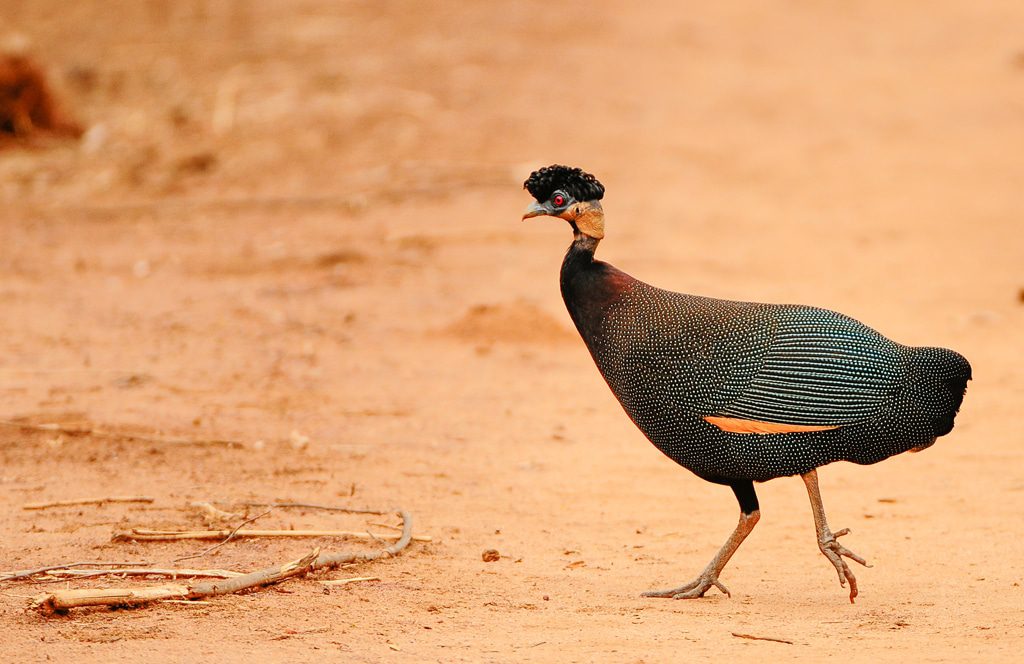
Helmeted Guinea Fowl – The ‘bush telegraph.’ These ground-dwelling birds are surprisingly loud and persistent when danger is near. Their harsh, staccato calls can reveal a lurking lion or a prowling leopard, even before a human tracker sees a paw print. Fun fact: guinea fowl have incredible eyesight and often detect predators while other animals remain unaware, making them the ultimate early warning system in the bush.
Vultures – the classic signpost in the sky. When white-backed or hooded vultures circle slowly above the treetops, it’s rarely idle – somewhere below is a fresh kill, and predators are feeding. Vultures can spot carrion from kilometres away, and their soaring circles can guide trackers straight to lions, hyenas or leopards. Did you know vultures also help the ecosystem by cleaning up carcasses, reducing the spread of disease?
The beauty of tracking with birds is that they’re honest informants. They don’t cry wolf without reason; every alarm, every change in behaviour has a cause.
Think of the bush as a living radio network. Every creature has a voice, and birds are some of the most vocal broadcasters.
A few examples from our game drives:
These cues aren’t just useful for finding wildlife – they make the safari experience richer. Guests begin to see the bush as a web of connections, where everything is linked.
Lorem ipsum dolor sit amet, consectetur adipiscing elit. Ut elit tellus, luctus nec ullamcorper mattis, pulvinar dapibus leo.

Some people hear “birding” and think of quiet walks with binoculars, simply checking species off a list. And while that’s a joy in itself (and something we love to offer), here at Royal Zambezi Lodge, birding can mean high adrenaline moments too!
Because when you’re out here in the bush, watching the birds isn’t just about the birds – it’s actually about what they’re watching. The sudden scatter of a quelea might be the prelude to a peregrine falcon’s drive. The agitated calls of hornbills might mean a python is moving through the branches.
On our Zambia birding safaris, we weave bird sightings into the broader story of the bush. You’ll learn how to read the signs, link the dots between species and maybe – just maybe, follow a bird’s warning call straight to a lion’s golden eyes.

Every drive, every walk here is an open air classroom – and your teachers are guides themselves. At Royal Zambezi Lodge, our team has spent decades immersed in these landscapes, learning not just to identify bird calls, but to interpret their urgency and meaning. Their deep knowledge isn’t just about book learning; it’s honed through years of tracking leopards, lions and elephants and reading the bush like a living map.
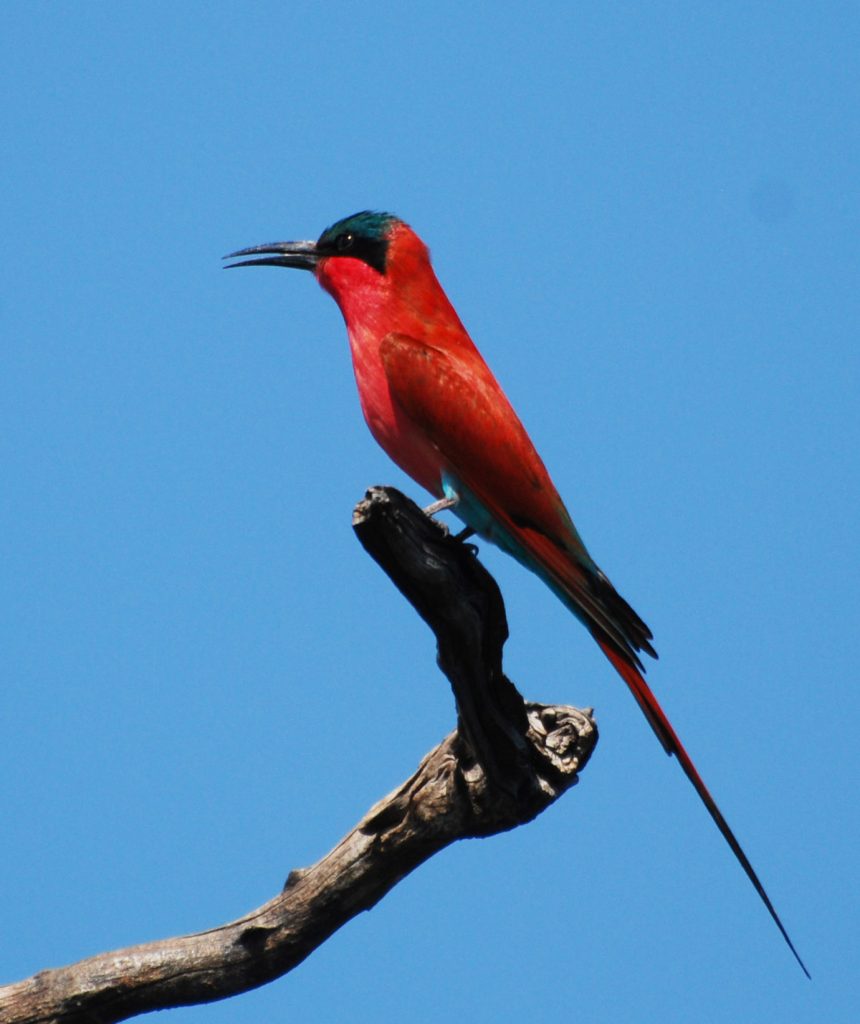
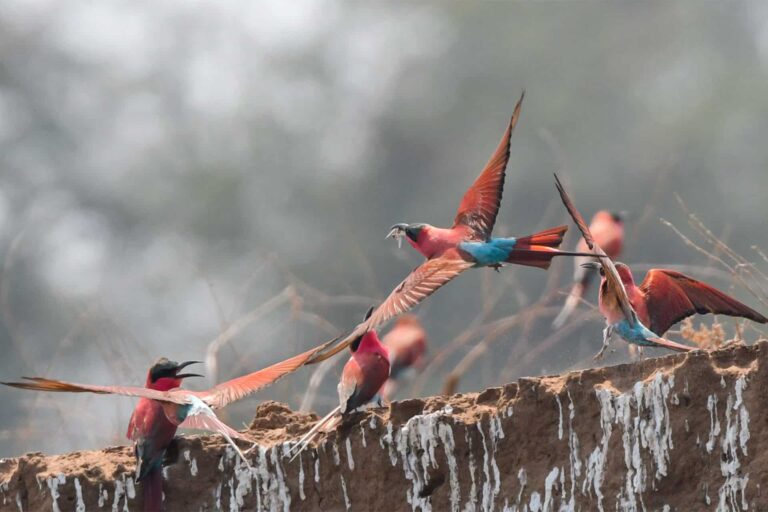
And while we’re passionate about sharing the rich diversity of African bird species – from the brilliant carmine bee-eaters to the stately saddle – billed stork, our guides love showing how these feathered friends connect to every other safari experience.
Next time you join us on a drive along the Lower Zambezi, keep your ears open. Maybe it’s the raucous call of a guinea fowl, the frantic chatter of drongos, or the distant arc of vultures in the sky. Each is a story unfolding – one you might be lucky enough to follow to its thrilling conclusion under the guidance of our experienced trackers.
Because here in Zambia, the birds aren’t just background music. They’re guides, informants and sometimes the key to your most unforgettable sighting, and with our team by your side – you’ll never miss a note.